
How to Get More from a Medical Conference
You return with new contacts, scientific updates and a notebook full of ideas. A month later, what has your team actually used?
Medical conference planning works best when the learning has somewhere to go. Follow this fictional Medical Affairs professional as one question travels from preparation to a useful team discussion.
01 / BeforeBuild your conference strategy around a question
Her Medical Affairs conference strategy begins with a team need:
What should our team understand differently after this conference?
She selects relevant sessions, reads available abstracts and identifies people who could clarify uncertainties. Colleagues divide coverage, leave room for conversations and reserve a debrief before they travel.
02 / DuringCapture the insight and its context
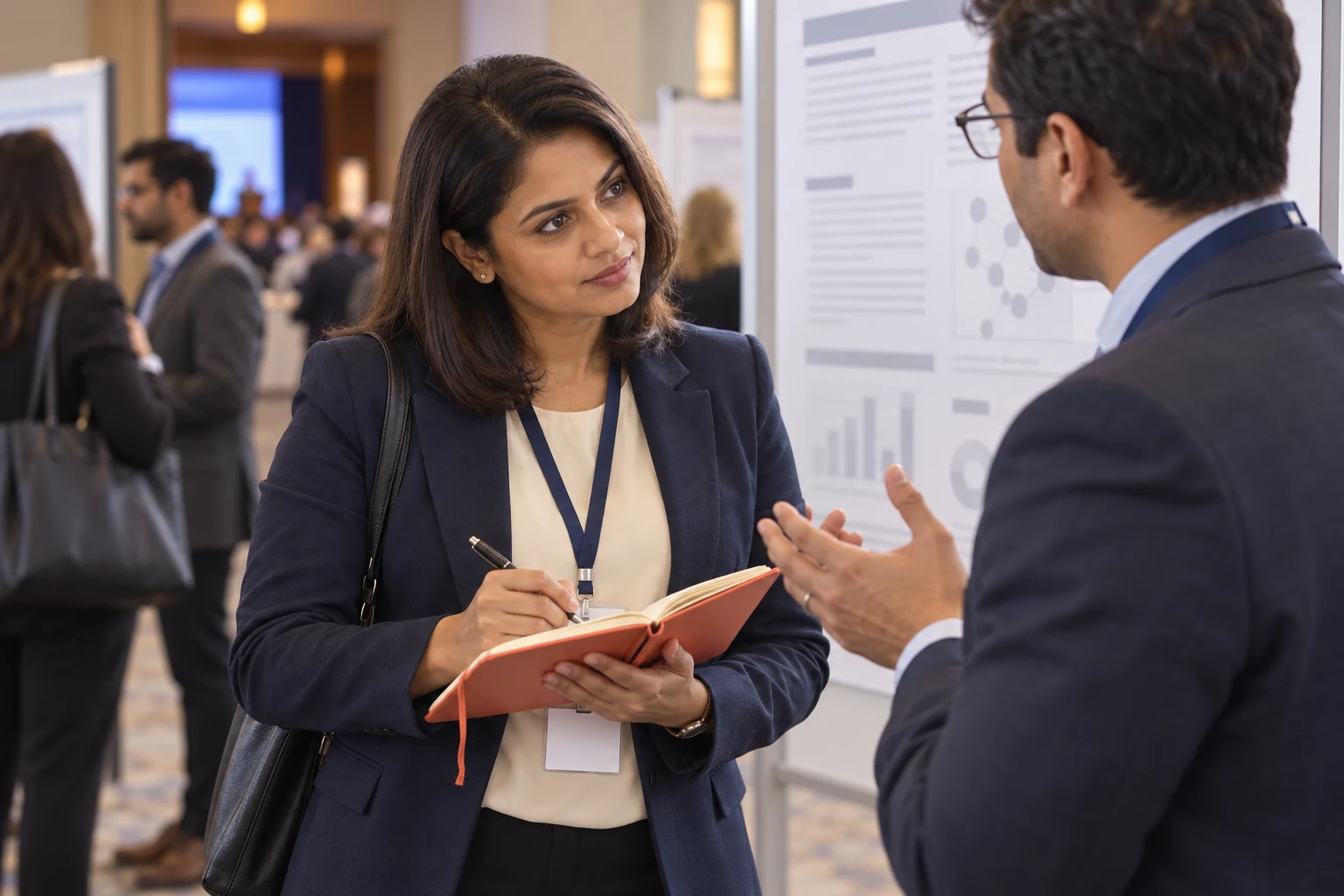
At a poster, she asks which population a finding describes and what remains unanswered. Her note keeps four things together: the takeaway, source, limitation and follow-up question.
She separates presented evidence from a speaker's interpretation and her own idea. Each evening, she selects what answers the original question and records who needs a follow-up. She checks event permissions before photographing or sharing material.
03 / AfterGive the learning a useful next step

Her post-conference debrief returns to the same question. A short explanation shows what she learned, why it matters to this team and what still needs checking. Each follow-up has an owner and a date.
Using permitted source material, the team can repurpose selected scientific content into a source-based scientific presentation or infographic for colleagues who could not attend. Keep the evidence limitations visible and complete the appropriate review before wider use.
Explore Bionidi for Medical Affairs when selected evidence is ready to become clear scientific content.
Reading behind the story: Leininger and colleagues, PLOS Computational Biology (2021), on preparation, participation and follow-through; and an academic discussion about forgotten conference notes. The latter is an adjacent-audience account, not a representative study. All scenes are AI-generated illustrations of fictional people.