
How to Update Medical Content When a Source Changes
A publication correction can leave an approved slide telling an outdated story. For Medical Affairs teams, the task is to update medical content wherever that finding appears, then check that each revised asset still communicates the source accurately.
Start with the exact change
Compare the current publication with its correction notice and earlier version. ICMJE recommends documenting journal corrections, retaining previous versions and citing the latest version.1 Apply that version awareness to your content: record what changed before deciding which assets need review.
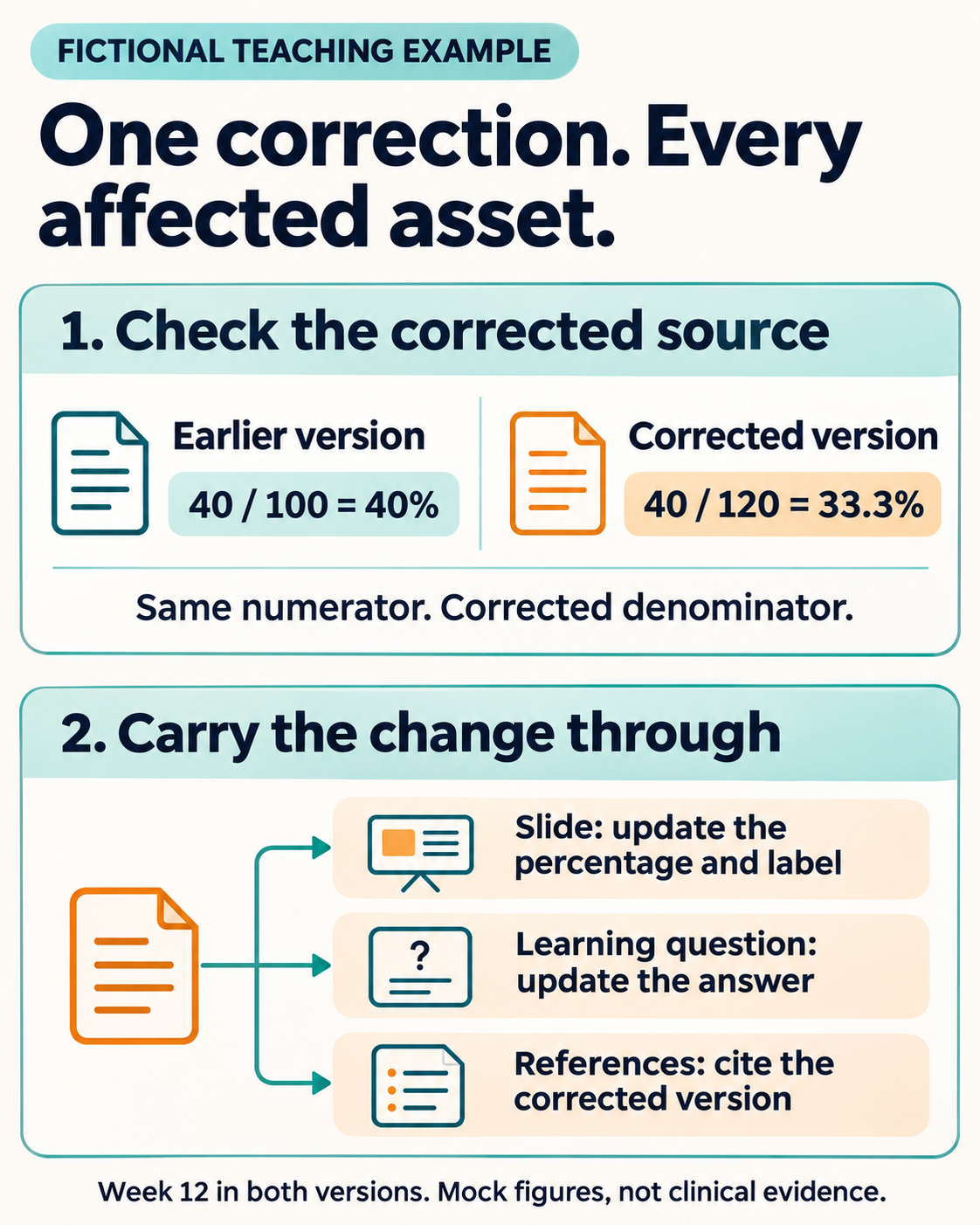
Follow the finding into each asset
In this fictional example, replacing the reference alone leaves the old percentage in circulation. Update the slide label and any chart built from it. Then find the same finding in the learning question, answer and explanation. Check captions, speaker notes and downloadable copies too. If the correction changes a conclusion, route that interpretation to the appropriate scientific reviewer.
Release a traceable replacement
Keep a compact handover record so the next reviewer can see the relationship between the changed source and the finished content.
Before release, recheck the revised words and visuals against their sources. Archive superseded files and identify the current approved version through your team's process.
Bionidi supports source-based Medical Affairs content creation with evidence traceability. Use that source connection alongside your change record; it does not replace scientific review or establish automatic updates across every asset.
Source: ICMJE, Corrections and Version Control, accessed 13 November 2026. The asset workflow is a practical adaptation of journal version-control principles. Cover photograph and diagram are generated illustrations.